I take pride in the fact that I was the first of my friends to find out about Derrick Comedy. Bro Rape, Keyboard Kid, Opposite Day…these were all hits, and we’d play them every week as I made the trip from the South Loop where my dorm was to Lincoln Park to drink wine and play Wii with them nearly every weekend. We anticipated new shorts and would see who could post them to the others’ Facebook walls first. Since that semester, we’ve see the guys develop an enormous fanbase, culminating in a feature film that we all watched at the Music Box Theater (the first and only time I’ve been to that theater). Donald Glover has gone on to achieve eternal relevancy, first through his hip-hop outlet Childish Gambino, then writing for 30 Rock, starring in Community and the ultimate form of immortality: being “criticized” on Hipster Runoff.
The other two guys have managed to keep a lower key. I often see tweets of theirs plugging comedy shows at UCB theaters and various other places around New York and LA. Whereas Glover’s success may appear to be the endgame for anyone who starts an independent web series, Dominic Dierkes and DC Pierson have gone the more typical route, and having remained out of the spotlight, can latch on to more experimental paths. To start a rap career, Donald rapped over a bunch of Sufjan Stevens jams, which expanded to other indie bands and eventually original material. The impetus may have been a three AM falling asleep half-thought or originally just a joke. But it developed. Conversely, Pierson lets us know why he wrote this book: Eliza Skinner told him to on the N train one day.
Knowing Pierson’s background in absurdist and intelligent comedy, it was hard to exactly know what to expect from this novel (his first) that on the back cover announces its describing the ‘typical high school experience.’ The title was sort of dumb and the writing started off supporting that assessment. High school kid hates popular kids in high school and feeling underappreciated for the phenomenal human being that they are. Yes, I guess that is the ‘typical high school experience,’ something that anybody who would even know who DC Pierson is already went through. Why do we want to go through it again?
As it turns out, it gets much, much better from there. The main character, Darren, soon meets our title character, Eric, who as we start to gather, never sleeps. Ever. And he never feels tired. He reveals his secret to Darren who is in disbelief, wondering how why how? He asks the same questions you would be asking: how does he not get tired? Doesn’t he have a subconscious? Naturally, this is a fiction novel, not science fiction, and Pierson isn’t concerned about scientific accuracy as much as simply suspending your belief in objective reality enough to enjoy the story. It starts out simple enough, they hangout, realize they have a lot in common, create an entire cultural empire surrounding a science fiction movie plot (drawings included)…until a girl gets involved (oh shit!). Yes, soon Darren, the more ‘normal’ of the two is getting it on semi-regularly and starts to ignore Eric. And when Darren’s inevitable awkwardness fucks things up with her (Christine), she runs to Eric and the two of them (you guessed it) eventually get together. It was a bit predictable, but Pierson runs with it in a great way. Darren gets so frustratingly heartbroken and even Eric warps out of character, threatening violence and sending Darren pics of himself and Christine. What a dick, right? Really does make you glad you’re not in high school anymore.
And yet, I feel like that is the primary targeted readership: high schoolers. Not to slight the book. On the contrary. For the kids that need something more contemporary than Catcher in the Rye or feel The Perks of Being a Wallflower too ‘emo,’ Pierson offers a voice that deals with the issues that he himself is not too removed from (popularity, puberty, social media, overactive imagination) without being condescending. Naturally, the Internet plays a big role, from email to porn to Namespot (why reference Garageband and not Facebook?). The book was a breeze too; easily manageable to finish in one day if you have the time. It’s engaging albeit with simple language, but hey, it’s supposed to be from the point of view of a sixteen year old. Oh yeah, plus Eric goes on these wild hallucinations and eventually manifests his thoughts into existence. And did I mention he never sleeps? Yeah, some cool shit happens.
Showing posts with label book report. Show all posts
Monday, October 24, 2011
Wednesday, October 12, 2011
Gabriel Garcia Marquez - One Hundred Years of Solitude
I can’t finish this book. 90 pages has taken nearly a month.
Every paragraph I read is a jumble of words that I derive no meaning out of. It
is frustrating on two accounts. One for the fact that it is considered a
classic and definitive example of magical realism and the Latin American boom
in the 60s and 70s. I want to be able to better understand this culture, to
just try to attempt to see how they interpret the world around them. Instead, I
find a muddled composition that takes no time to develop any true meaning or
connections between the characters. It’s necessarily a fragmented story
(despite its non-linearity) but rather the jumpiness doesn’t lead me to care
about or empathize with anyone.
Second, I hate not being able to finish books. It shouldn’t
matter. If an album or movie is boring, I’ll turn it off, but I still hold
literature in such a high regard. I’m Jack in The Designated Mourner, you know, before he shit on all of his
books. I’ve only done this with one other book: Catch-22. Granted, I was still in high school, just figuring out my
place in the literary world and what interests me, but that one bored me to no
end. It’s something I may be able to give another chance further down the road
though. 100 Years of Solitude
however…do I just have to admit I only like white, male authors? Not to infer
I’m racist or sexist, and especially not on any conscious level, but for every Beloved I read there are fifty Tropic of Cancers that are as compelling
to me. I’m not gonna bemoan the fact that I was granted the most privileged
birthright possible in our society (white, straight, male), but I hate to admit
the limitations that come with the territory.
So how should I react? Have I just not tried enough? Marquez
doesn’t speak for all Latin American culture. And The Savage Detectives is one of my favorite novels. Although I
certainly could live my whole life and never leave the realm of those white,
male authors that I will surely feel most comfortable reading, or at the very
least, ‘get.’ But I do like curveballs. I like being confused sometimes. I want
to read something and think ‘what the fuck?’ Just as I want to listen to
something that I’ve never listened to before and watch something through a new
perspective. Murakami is on my to-read list but I might have to rock some more
Sedaris first. Maybe it’s just a summer thing and I feel more open to reading
in the fall, the last leaves in the trees rustling outside my window, the
streetlights turning on earlier and better concentration through evening
coffee.
Wednesday, June 22, 2011
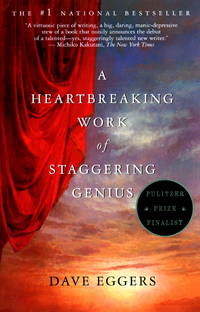
Dave Eggers - A Heartbreaking Work of Staggering Genius
It’s been at least six years since I was first recommended this book. At the time it could still have been considered contemporary; now it’s at the top tier to describe the popular memoir genre popular circa Y2K. Not unlike stumbling across Bourdain’s Kitchen Confidential amidst a random stand at Printer’s Row Lit Fest, a cosmic event considering the time his show has recently consumed in my life, so too did I find this book, at the same exact stand. Ok, fine. I’ll finally give it a shot.
The first chapter involves his mother living with cancer.
I immediately feel another cosmic event. Well, not really. But it’s an astounding coincidence that piques my interest and I’m hooked. It becomes less personally relatable from then on, but the self-conscious writing style is right up my alley. The breaking of character dialogue, his younger brother becoming more poignant than himself, acting as the voice inside himself, the beyond honest (post-honest?) style of writing, the vulgar language, the overall…ok, this book pretty much hits all of my buttons (let’s call this style “me(ta)moir”). In particular, it’s the honesty. That one trait that will hold me back from being a good or even decent writer. I don’t anticipate writing novels (my attention span has unfortunately become Twitterized) but I want to at least write a fucking blog post, which only five people will even read, and just. be. honest.
Wednesday, March 23, 2011
Book Report: Patti Smith - Just Kids
Whenever I read anything even remotely relating to the New York punk scene in the 70s, I get an immediate rush of inspiration. It’s not even always to create something or be proactive, but just to read about people’s lives in the time is so fascinating. I feel truly lucky to be living in a time of such proximity so as to be able to learn about such an explosive era of modern culture. And even though I own no albums by Patti Smith, nor have beyond a vague introduction to Robert Mapplethorpe’s photography, the former’s account of their relationship is simply just too interesting to put down. CBGB’s is nothing more than a hiccup in this book, a break from digesting their dynamic time together. In an oddly voyeuristic stance, I yearned to feel as close to anyone as they did to each other. The key component of this work is the brilliance of Smith’s writing. And despite perhaps an overuse of the word ‘talisman’ (although overused for a reason), I hanged on every word as poor Robert hung on to every last blood cell.
Labels:
book report,
just kids,
patti smith,
robert mapplethorpe
Tuesday, December 7, 2010
Book Report: Vladamir Nabokov - Lolita
The amazing thing about literature is the ability to push the reader towards the realm of discomfort and disdain while still retaining the essential elements of great writing. Henry Miller is one author that comes to mind immediately. I could never defend the actions of the misogynistic, anti-Semitic protagonists of the Tropic duo, but goddamn was the writing just so perfect in those novels. Great passages would turn into pages of every single word having its specific purpose, every article and seemingly secondary adjective contributing as much as the more prominent nouns and pronouns. The plots could be boiled down to Miller’s own take on two cities (New York and Paris) and his personal exploits within, without much central conflict, rising or falling actions. With a rather trivial storyline, it is too tempting to ask “What is the point of these novels?” And going further, “Is this pornographic or literary or both? Is there a place for pornography in literature?” In an afterword to Lolita, Nabokov takes initiative in answering the former: “I happen to be the kind of author who in starting to work on a book has no other purpose than to get rid of that book.” He recognizes that he is less of a conscious ego declaring himself as writer, more of a fortuitous vehicle for a book that has to be written (a great essay on this concept can be found here).
I am not here to set about answering these questions, as that would take an entirely more formal essay that I don’t think the minimal readership of this one warrants the time it would take to fully deconstruct. Rather, I am more interested in exploring the conflict between author and reader when confronted with a novel such as this. Early on, when our mainman Humbert Humbert is expressing the agony inflicted by his desire to have his future step-daughter Delores Haze, you really can’t feel any sympathy. We already know that he is giving a testimony before a jury, that he is a murderer and a pedophile. And yet, the expression of this pain almost wins the reader over. And when his Lolita eventually deserts him, his rage and murderous contempt is almost justifiable. It’s this discomfort as a reader that draws me in so much. Can I really acquit a pedophile of his crimes if he were to repudiate them and serve his time? Moreover, for a pedophile, Humbert is quite the charmer and is never vulgar. And here I exist in the world, the mouth of a sailor, and although understanding of references to Hegel and Schlegel, have never taken the time to familiarize myself with them the way this old European corrupting young America (or vice versa) has.
Away from the novel’s content and onto the form, it would be hard to guess that English was Nabokov’s second language. He developed quite the masterful subtleties and extensive vocabulary to create such phrases as “a pharisaic parody of privacy” and “burning with desire and dyspepsia.” He is able to eloquently articulate his character’s intellectual depth: “We live not only in a world of thoughts, but also in a world of things. Words without experience are meaningless.” And: “A change of environment is the traditional fallacy upon which doomed loves, and lungs, rely.” Whether or not it is Nabokov that actually believes this is not what is important, but rather as he puts it, that he needs to get rid of these ideas that bubble and fester inside of him.
Ultimately, the fate of H.H. has to be doomed. Lolita will not stay a nymphet forever. Even had she never ran away, the relationship would be strained over time regardless. He even begins to notice it himself, although even when he tracks her down years after she leaves him, he still attempts to convince her to leave her husband and come back to him. Can love that strong exist? His desire for her was mostly fueled by her youthful features and he used to consider the high school and college aged girls too old for his type. Yet when she enters this stage of life, he still has those feelings. And what could it be in him that develops these feelings? Was it the episode that he describes at a young age of his first relationship as a pre-teen? Could his view of love never mature even as his body did because of that? And these questions continue to exist today, as there is more pressure on the youth to become sexualized younger and younger (tangent: flipping through, I just found another great combination of words: “the most auburn and russet, the most mythopoeic nymphet in October’s orchard-haze.”) A good novel is often characterized as being timeless, a trait defined by its ability to remain relevant over time and raise questions and promote discussion over time. This is no doubt achieved in Lolita in not only its suggestive content but the experimental form as well. Never dense, but enough of a struggle to maintain worthwhileness, it is no wonder the book is considered a masterpiece.
I am not here to set about answering these questions, as that would take an entirely more formal essay that I don’t think the minimal readership of this one warrants the time it would take to fully deconstruct. Rather, I am more interested in exploring the conflict between author and reader when confronted with a novel such as this. Early on, when our mainman Humbert Humbert is expressing the agony inflicted by his desire to have his future step-daughter Delores Haze, you really can’t feel any sympathy. We already know that he is giving a testimony before a jury, that he is a murderer and a pedophile. And yet, the expression of this pain almost wins the reader over. And when his Lolita eventually deserts him, his rage and murderous contempt is almost justifiable. It’s this discomfort as a reader that draws me in so much. Can I really acquit a pedophile of his crimes if he were to repudiate them and serve his time? Moreover, for a pedophile, Humbert is quite the charmer and is never vulgar. And here I exist in the world, the mouth of a sailor, and although understanding of references to Hegel and Schlegel, have never taken the time to familiarize myself with them the way this old European corrupting young America (or vice versa) has.
Away from the novel’s content and onto the form, it would be hard to guess that English was Nabokov’s second language. He developed quite the masterful subtleties and extensive vocabulary to create such phrases as “a pharisaic parody of privacy” and “burning with desire and dyspepsia.” He is able to eloquently articulate his character’s intellectual depth: “We live not only in a world of thoughts, but also in a world of things. Words without experience are meaningless.” And: “A change of environment is the traditional fallacy upon which doomed loves, and lungs, rely.” Whether or not it is Nabokov that actually believes this is not what is important, but rather as he puts it, that he needs to get rid of these ideas that bubble and fester inside of him.
Ultimately, the fate of H.H. has to be doomed. Lolita will not stay a nymphet forever. Even had she never ran away, the relationship would be strained over time regardless. He even begins to notice it himself, although even when he tracks her down years after she leaves him, he still attempts to convince her to leave her husband and come back to him. Can love that strong exist? His desire for her was mostly fueled by her youthful features and he used to consider the high school and college aged girls too old for his type. Yet when she enters this stage of life, he still has those feelings. And what could it be in him that develops these feelings? Was it the episode that he describes at a young age of his first relationship as a pre-teen? Could his view of love never mature even as his body did because of that? And these questions continue to exist today, as there is more pressure on the youth to become sexualized younger and younger (tangent: flipping through, I just found another great combination of words: “the most auburn and russet, the most mythopoeic nymphet in October’s orchard-haze.”) A good novel is often characterized as being timeless, a trait defined by its ability to remain relevant over time and raise questions and promote discussion over time. This is no doubt achieved in Lolita in not only its suggestive content but the experimental form as well. Never dense, but enough of a struggle to maintain worthwhileness, it is no wonder the book is considered a masterpiece.
Tuesday, November 9, 2010
David Sedaris - Naked
Why did I wait so long to read this book? Been on my list for years, finally decided to forego my usual desires to read 40s/50s Euro lit and delve into some contemporary memoirs. Rather than giving A-B-C event timelines, Sedaris focuses on specific events in his life and elaborates to the fullest extent on each one. Despite a brief internet search, I’m still unsure as to the actual validity of these stories, but as Tim O’Brien was the one who got me into literature, answering that question is the low man on this totem pole. Considering the imagination of Sedaris, it is not important if these are actual events. The meaning lies in digging out every piece of dark humor possible, from deceiving the world with a quadriplegic to getting high with his siblings while their mother sits alone on the cusp of death. The callousness of the protagonist can only be conveyed in a book titled Naked. No, his mother wasn’t the sweetest, but he recognizes his own naivety about his cold emotions without changing them. And he shares them. He lets us put on his X-ray specs by putting these words on pages between the covers. The back and forth between imagination (Chipped Beef) and straightforwardness (I Like Guys) creates a surreal landscape, populated by vulgar and awful people (C.O.G., Something for Everyone).
Of course, the point would be missed if we were to pass any judgment on these characters. What this book does is allow us to think of ourselves naked, to bring to our conscious the things we’re afraid to admit to anyone but ourselves. And this is where the book becomes most meaningful to me. I’ve become increasingly aware that I will never be a true writer. Writing involves such a strong foundation of honesty that I will never be able to achieve. As an internalizer, it’s difficult for me to express true feelings to anyone else and (amazingly) this difficulty is true for print as well. While I find no difficulty expressing my opinions on the work of others, why this book is great or why that band sucks or why I have so little interest in a lot of movies everyone clamors for, I view what I feel as so meaningless as to not even look at the map of that train line. And perhaps this is only a continuation of a path I’ve been following since high school, the rationalist vs. the empiricist, the big-picture of the world and the small timeframe that my life takes up. Either way, I will never write a Naked. I may write Winter Clothing, in which I continue to hide by never putting my Self out there. Playing it safe is dangerous territory for an aspiring writer. Alas, don’t expect me to quit my job and go play in the street.
Music: Braids – Set Pieces EP, Radar Eyes – S/T
Of course, the point would be missed if we were to pass any judgment on these characters. What this book does is allow us to think of ourselves naked, to bring to our conscious the things we’re afraid to admit to anyone but ourselves. And this is where the book becomes most meaningful to me. I’ve become increasingly aware that I will never be a true writer. Writing involves such a strong foundation of honesty that I will never be able to achieve. As an internalizer, it’s difficult for me to express true feelings to anyone else and (amazingly) this difficulty is true for print as well. While I find no difficulty expressing my opinions on the work of others, why this book is great or why that band sucks or why I have so little interest in a lot of movies everyone clamors for, I view what I feel as so meaningless as to not even look at the map of that train line. And perhaps this is only a continuation of a path I’ve been following since high school, the rationalist vs. the empiricist, the big-picture of the world and the small timeframe that my life takes up. Either way, I will never write a Naked. I may write Winter Clothing, in which I continue to hide by never putting my Self out there. Playing it safe is dangerous territory for an aspiring writer. Alas, don’t expect me to quit my job and go play in the street.
Music: Braids – Set Pieces EP, Radar Eyes – S/T
Labels:
book report,
braids,
david sedaris,
radar eyes
Subscribe to:
Posts (Atom)